
At Erie Powder Coatings, we know that news about “forever chemicals” (PFAS) can sound alarming. Regulatory headlines, changing state laws, and new insurance rules have left many of our customers wondering: Are the coatings on my products safe, and will I still be able to buy them?
Here is the short answer: Not all PFAS are created equal.
While media reports often treat PFAS as one single hazardous group, global regulators are actively separating dangerous water-soluble chemicals from the safe, solid plastics used in coatings. Here is what you need to know about the science, how governments view these materials, and how Erie Powder Coatings approaches manufacturing.
How Erie Powder Coatings Uses PFAS
First, let’s clear up what we actually make.
At Erie Powder Coatings, our use of PFAS is strictly limited to PTFE (polytetrafluoroethylene) additives, which we use exclusively to produce our sandtexture finishes.
PTFE provides the scratch resistance, mar protection, and distinct tactile feel that make sandtexture powder coatings so durable and popular.
Crucially, we exclusively source PTFE raw materials that are completely PFOA-free. We do not use legacy surfactants or toxic processing aids in any of our formulations.
Polymeric vs. Non-Polymeric: The Key Difference
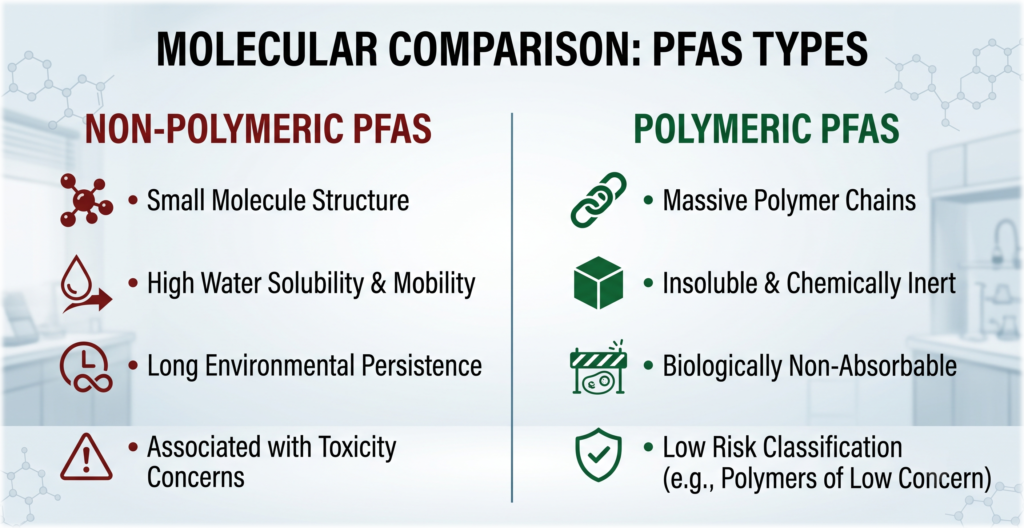
To understand why our sandtexture coatings are safe, it helps to break “PFAS” down into two very different categories: non-polymeric and polymeric.
1. Non-Polymeric PFAS (The Harmful Ones)
These are small, liquid-soluble molecules historically used in firefighting foams, stain repellents, and old manufacturing processes (such as PFOA and PFOS). Because they are small and dissolve in water, they can travel through soil, enter drinking water, and bioaccumulate in human and animal tissue. Erie Powder Coatings does not use these chemicals.
2. Polymeric PFAS (The Safe Plastics)
Materials like PTFE are fluoropolymers; massive, solid macromolecules made of tightly bound chains.
-
Inert & Solid: Once cured into a powder coating, PTFE forms a completely solid, non-reactive plastic surface.
-
Biologically Inactive: Because the molecules are so massive, they cannot dissolve in water, cross biological membranes, or accumulate in living tissue. International health bodies classify them as Polymers of Low Concern.
-
Stable: They do not break down into toxic non-polymeric chemicals under normal environmental conditions.
How Global Governments View Fluoropolymers
Because the science clearly shows that solid polymers behave differently than small liquid chemicals, regulatory bodies around the world are adjusting their approach:
-
Canada: Canada initially considered banning all PFAS under a single umbrella. However, after reviewing toxicological evidence, Environment and Climate Change Canada (ECCC) updated its assessment to exclude solid fluoropolymers from its toxic substance restrictions.
-
European Union: Europe’s proposed chemical restrictions originally grouped all PFAS together. European regulators are now carving out specific exemptions and pathways for fluoropolymers, recognizing their safety and essential role in high-performance products.
-
United States (EPA): The U.S. EPA currently uses a broad definition that groups all fluorinated compounds together for basic reporting rules. However, federal regulators are widely expected to follow Canada and Europe by creating clear exemptions for solid, inert polymers like PTFE when setting actual restrictions.
The Insurance Challenge: Science vs. Underwriting
If the science and government regulators agree that solid fluoropolymers are safe, why are customers still hearing about “PFAS bans”?
The issue today isn’t the law; it’s commercial insurance.
Many insurance underwriters have begun adding broad PFAS Exclusions to corporate liability policies. Because insurance companies often use catch-all definitions, these exclusions sometimes lump safe, solid PTFE in with high-risk liquid contaminants.
This creates temporary confusion for buyers and specifiers, even when the product is fully compliant with environmental laws. As regulatory exemptions for fluoropolymers become finalized worldwide, we expect insurance policies to eventually catch up with the science.
Our Promise to You
At Erie Powder Coatings, we are committed to providing high-performance coatings that protect both your products and the environment:
-
100% PFOA-Free Sourcing: We verify that all PTFE additives used in our sandtexture powders are strictly free of PFOA and legacy contaminants.
-
Focused Application: We only use PTFE where it is functionally necessary to deliver durable, scratch-resistant sandtexture finishes.
-
Regulatory Compliance: We actively monitor North American and global chemical regulations to ensure your coatings remain fully compliant. We continue to put efforts into the development of completely PTFE free sandtexture finishes. While we do have alternatives available, the performance does not yet match that of the PTFE containing products.
If you have questions about specific product specifications, safety data sheets, or regulatory documentation for your finishes, our technical team is always here to help.